Wing area and stall speed
Andrea Stella ·
Calculator investigation
Aim and method
I wanted to see how a larger wing would affect the minimum speed needed to keep the same aircraft in level flight. After looking at the calculator, I expected stall speed to fall, but not in direct proportion to the increase in area.
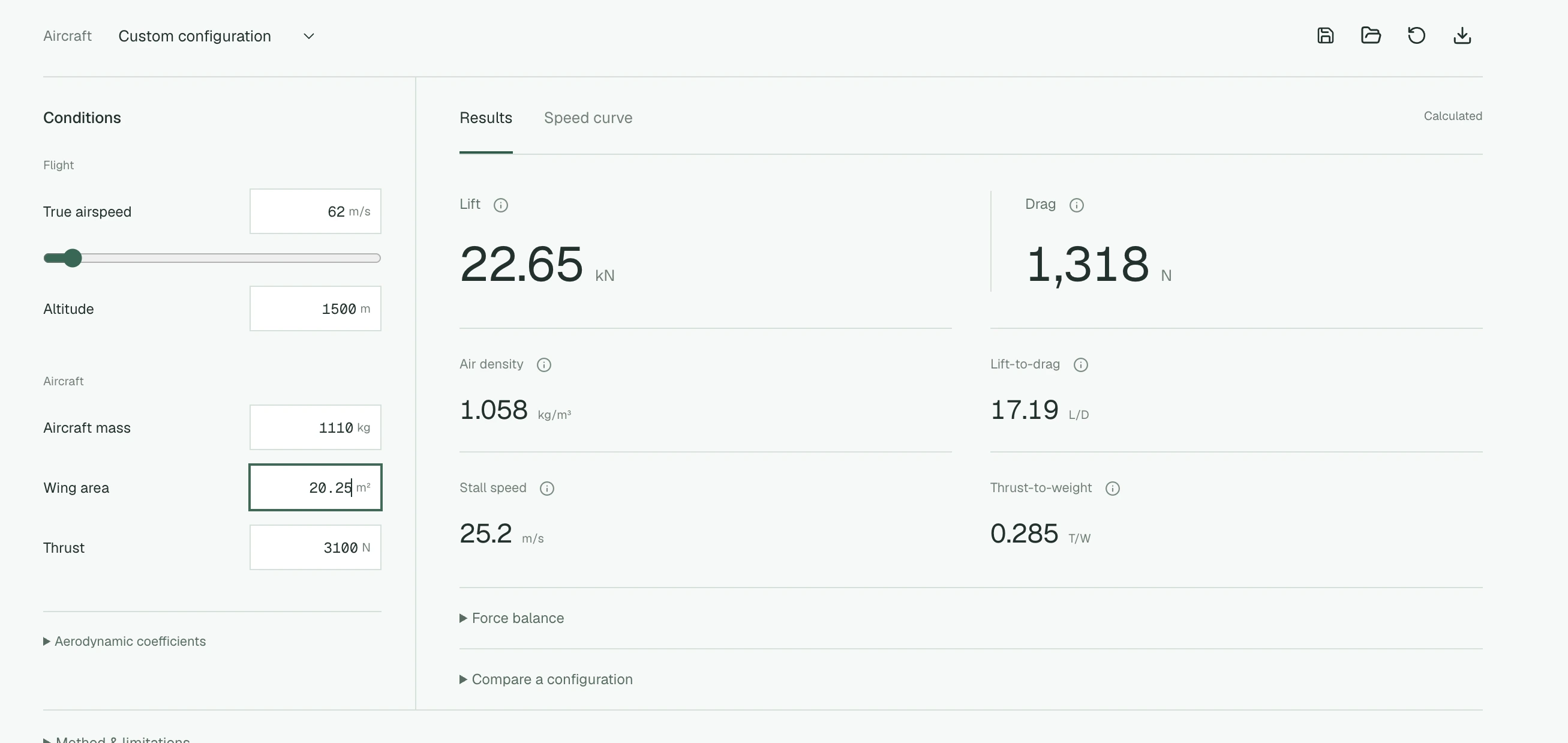
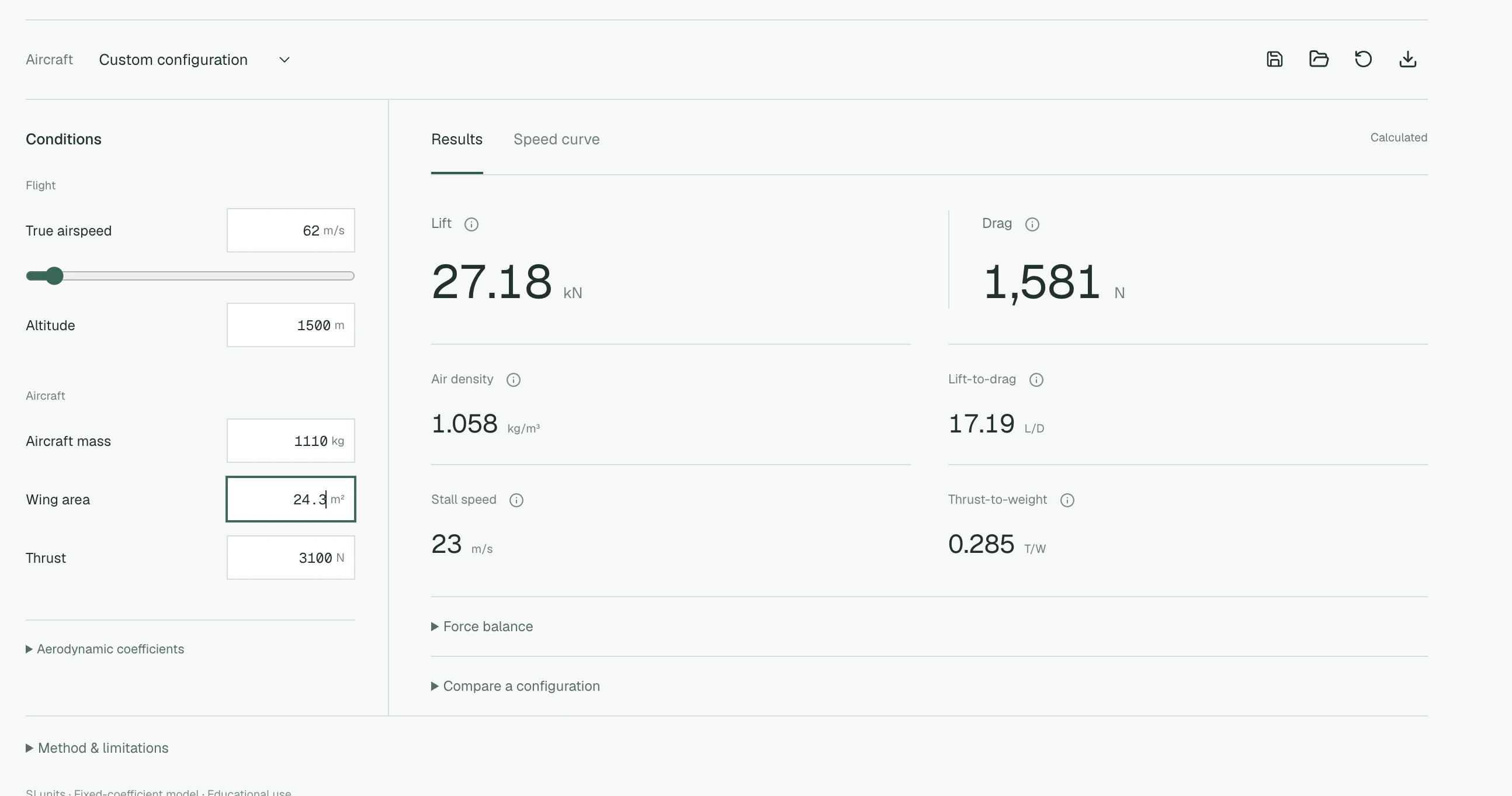
I started with the Light aircraft preset and changed wing area from 16.2 m² to 20.25 m², then 24.3 m²: increases of 25% and 50%. I kept all other inputs unchanged and recorded the estimated stall speed for each area.
Mass stayed at 1,110 kg, altitude at 1,500 m and maximum lift coefficient at 1.6. The calculator estimated air density as 1.058 kg/m³.
The remaining preset inputs were 62 m/s airspeed, CL = 0.55, CD = 0.032 and 3,100 N thrust. These are assumed example values, not measurements from a specific aircraft.
Results
| Wing area | Stall speed | Reduction |
|---|---|---|
| 16.2 m² | 28.2 m/s | Baseline |
| 20.25 m² | 25.2 m/s | 10.6% |
| 24.3 m² | 23.0 m/s | 18.4% |
The 25% larger wing reduced estimated stall speed by 10.6%; the 50% larger wing reduced it by 18.4%. My prediction was right: more wing area helped, but the speed reduction was smaller than the area increase.
Calculator scenarios: Original wing · +25% area · +50% area
Calculation
The lift equation is L = ½ρV²SCL. To estimate stall speed in level flight, I set maximum available lift equal to the aircraft's weight (mg). Rearranging gives:
Here ρ is air density, S is wing area, m is mass and g is gravity. Using the 20.25 m² wing:
Vs = √[(2 × 1110 × 9.80665) / (1.058 × 20.25 × 1.6)] ≈ 25.2 m/s
With the other terms fixed, stall speed varies as 1/√S. For 50% more area, 1/√1.5 ≈ 0.816: about 18.4% below the original speed. The square root explains why the reduction is not 50%.
What I learned
I initially described the upward force as thrust, but it is lift. I also understood the difference between CL = 0.55, used for the displayed lift at 62 m/s, and CL max = 1.6, used for the stall estimate. The calculator does not automatically adjust these inputs to balance lift and weight.
My first concern with a larger wing was extra weight and reinforcement. Lower stall speed is useful, but it does not make the biggest wing the best choice. I also learned that a wing bending does not automatically mean it is weak.
Limitations
This was a calculator comparison, not a physical flight test. A real wing redesign could change mass, drag, stability and maximum lift coefficient; I held those factors fixed to isolate wing area.
Calculator screenshots
I took these screenshots during the two larger-area runs. They show calculated results, not flight measurements.